
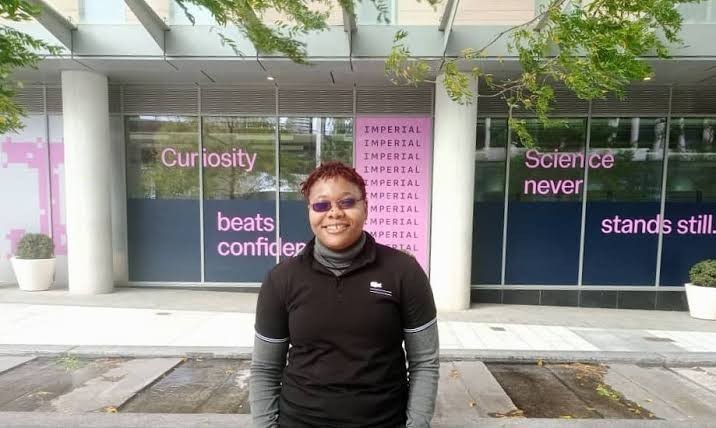
Mary-Brenda Akoda, a Nigerian AI researcher, software engineer, and founder, has won the 2026 Nigeria Prize for Science and Innovation (NPSI) for GenScan AI, also known as GenMRI/C-MORE, software that can reduce MRI scan times by up to 90% on existing machines.
Akoda becomes the first woman and first millennial to win the Prize as an individual recipient, a historic milestone in the award’s history. She will receive the US$100,000 prize at The Grand Award Night scheduled for 9 October 2026.
The winner was announced at the 2026 NPSI Press Conference in Lagos, following a rigorous, independent evaluation by the Prize’s Panel of Judges and endorsement by the NPSI Advisory Board. The panel was chaired by Dr. Omobola Johnson, Senior Partner at TLcom Capital LLP, who was unavoidably absent due to conflicting commitments. Other members included Professor Aminu Muhammad Bui, Professor of Artificial Intelligence at Usmanu Danfodiyo University, Sokoto, and Professor Collins Udanor Nnalue of the Department of Computer Science, University of Nigeria, Nsukka.
A Record Field and a Historic Comeback
The 2026 competition retained the theme “Innovations in Artificial Intelligence, ICT and Digital Technologies for Development,” attracting 237 entries — the highest number since the Prize began. The 2025 edition concluded without a winner after no entry met the exceptionally high standards required. The Advisory Board said this decision reflected its commitment to preserving the Prize’s integrity, credibility, and global standing.
“The return of a winner after the Prize recorded a ‘no winner’ verdict in 2025 demonstrates that the Prize’s standards remain uncompromising and reflect the quality and potential of Nigerian science and innovation,” said Dr Sophia Horsfall, General Manager, External Relations and Sustainable Development at Nigeria LNG Limited (NLNG), the Prize’s sponsor.
She added: “If an entry is declared worthy of the Prize today, we can be confident that it has earned that distinction through a thorough and credible evaluation process.”
Professor Barth Nnaji, Chairman of the NPSI Advisory Board, said the unanimous decision to recognise GenScan AI reflected both the innovation’s quality and its potential to address key healthcare challenges. He noted that the evaluation process was designed to identify work that goes beyond scientific novelty to demonstrate practical relevance, measurable impact, and prospects for real-world application.
The three finalists were:
1. GenScan AI (GenMRI/C-MORE) by Mary-Brenda Akoda;
2. EwaDx Smart Bra Diagnostic Device by Kemisola Bolarinwa; and
3. Accuracy and Reliability of MedBrain in Assisting Triage and Diagnosis of Common Acute Paediatric Conditions in Ethiopia by Pol Ricart and Paul Dinwoke.
Each demonstrated ingenuity, scientific merit, and a propensity to solve critical societal challenges. But after detailed assessments against the approved criteria — scientific novelty, technical soundness, developmental impact, scalability, and commercial potential — one entry consistently achieved the highest scores across all judges.
“I am therefore pleased to announce that Mary-Brenda Akoda’s GenScan AI was unanimously selected as the winner of the 2026 Nigeria Prize for Science and Innovation,” Professor Nnaji said.
The Innovation: Faster MRI Without New Machines
Magnetic Resonance Imaging (MRI) is slow, scarce, and expensive. Long scan times mean fewer patients per machine, longer waiting lists, more sedation for children or anxious patients, and delayed diagnoses.
GenScan AI uses a one-step consistency-model approach, known as C-MORE, to reconstruct high-quality images from far less acquired data. Hospitals would not need new scanners — only software for existing compatible hardware. In principle, a 20-minute scan could be reduced to two minutes, increasing throughput and access, especially in places like Nigeria, where MRI capacity is limited.
“The work’s AI-powered MRI reconstruction technology directly addresses a critical healthcare challenge by significantly reducing MRI acquisition times while maintaining, and potentially enhancing, image quality,” Professor Nnaji said.
According to a 2016–2018 survey published in the Pan African Medical Journal, Nigeria had 58 installed MRI machines. However, the current number of functional units may differ, and no single official, up-to-date database confirms it.
GenScan AI would not increase the physical number of MRI machines in Nigeria, but it could enable every compatible existing scanner to process far more patients, effectively expanding usable MRI capacity without buying new machines. By shortening the time per examination, it could reduce waiting lists and enable earlier diagnosis.
The judges noted that the innovation’s ability to improve scanner utilisation, reduce patient waiting time, and potentially expand access to MRI services makes it particularly relevant to healthcare systems in resource-constrained environments such as Nigeria.
Who Is Mary-Brenda Akoda?
Akoda’s academic credentials include study at leading UK institutions. She holds a First-Class Honours degree in Computer Science from Goldsmiths, University of London, and an MRes with Distinction in Artificial Intelligence and Machine Learning from Imperial College London, where she was a Google DeepMind Scholar.
She is a former software engineer and AI researcher at Microsoft, including at its Mixed Reality and AI Research Lab in Cambridge, and is now founder and principal researcher at GenScan AI.
Her earlier work includes patented AI for diabetic retinopathy detection in Nigeria; a children’s book on women inventors, Amazing Matriarchs; Grassroot Solar, which provides solar energy to rural communities; and a winning drone-based emergency-response concept developed during her time at the African Leadership Academy in South Africa.
Her broader significance is as a Nigerian woman developing clinically impactful generative AI for healthcare—ranging from early social-impact initiatives with Microsoft and Imperial research to a prize-winning MedTech company that facilitates quicker diagnoses without requiring new hardware.
Career, Research, and Recognition
Before founding GenScan AI, Akoda gained valuable experience in the technology industry. At Microsoft, she worked as a software engineer and AI research scientist, including at the company’s Mixed Reality and AI Research Lab in Cambridge. During an earlier internship, she applied deep learning to animate 3D human avatars from video and audio. She also contributed to Microsoft’s GOL Clinics West Africa programme, helping to establish the initiative and supporting 120 young people across West Africa with training in .NET, JavaScript, Git, Azure, and software design.
Her research at Imperial College London focused on Deep Generative Models for MRI Reconstruction, exploring cutting-edge deep generative AI techniques to improve the speed and quality of medical image reconstruction. Her research received support through the Fetch.ai Compute Award in February 2025.
Her other recognitions and achievements include:
· 2021 Nigeria Drone Business Competition: First place for her security-driven idea, Drone ER (Emergency Response).
· Founderland Forward Grant, Q4 2025: GenScan AI was selected to receive the $10,000 Forward Grant, recognising the potential of its AI solution for reducing MRI scan times.
· Innovate UK Recognition, August 2026: Innovate UK named her among 100 women founders shaping the UK’s future industries, highlighting her innovation for its potential to “speed up diagnosis, reduce NHS waiting lists, and improve care for millions of patients”.
· Social Innovation Award, May 2026: GenScan AI won a social innovation award for its MRI technology and secured a £10,000 grant.
Akoda’s historic win underscores the impact of an innovation born of personal tragedy and a determination to prevent others from suffering delayed diagnoses. Late diagnoses led to the loss of her grandfather. With a strong academic foundation from Goldsmiths and Imperial College London, and professional experience at Microsoft, she exemplifies a new generation of African innovators who leverage cutting-edge technology to solve critical healthcare challenges.
Mary-Brenda Akoda is from the Calabar South Local Government Area of Cross River State.
A Prize That Reflects NLNG’s Vision
The Nigeria Prize for Science and Innovation is sponsored by NLNG and is one of Africa’s largest, carrying a $100,000 award. It is comparable to the Nigeria Prize for Literature, which also carries a $100,000 prize. NLNG has also recently instituted a third prize for creativity.
The 2026 outcome marks the 12th time a winning work has been recognised in the Prize’s 22-year history, now rebranded as the Nigeria Prize for Science and Innovation.

NLNG congratulated Akoda and all participants in the 2026 competition, noting that each submission helps strengthen Nigeria’s scientific and innovation ecosystem. The company also appreciated the Nigerian media for its continued partnership in amplifying stories of scientific excellence and in encouraging greater interest in solutions to national challenges.
The Nigeria Prize for Science and Innovation is one of NLNG’s flagship initiatives to promote excellence in scientific research and innovation, with the ambition of encouraging solutions that deliver meaningful and sustainable impact on society.