
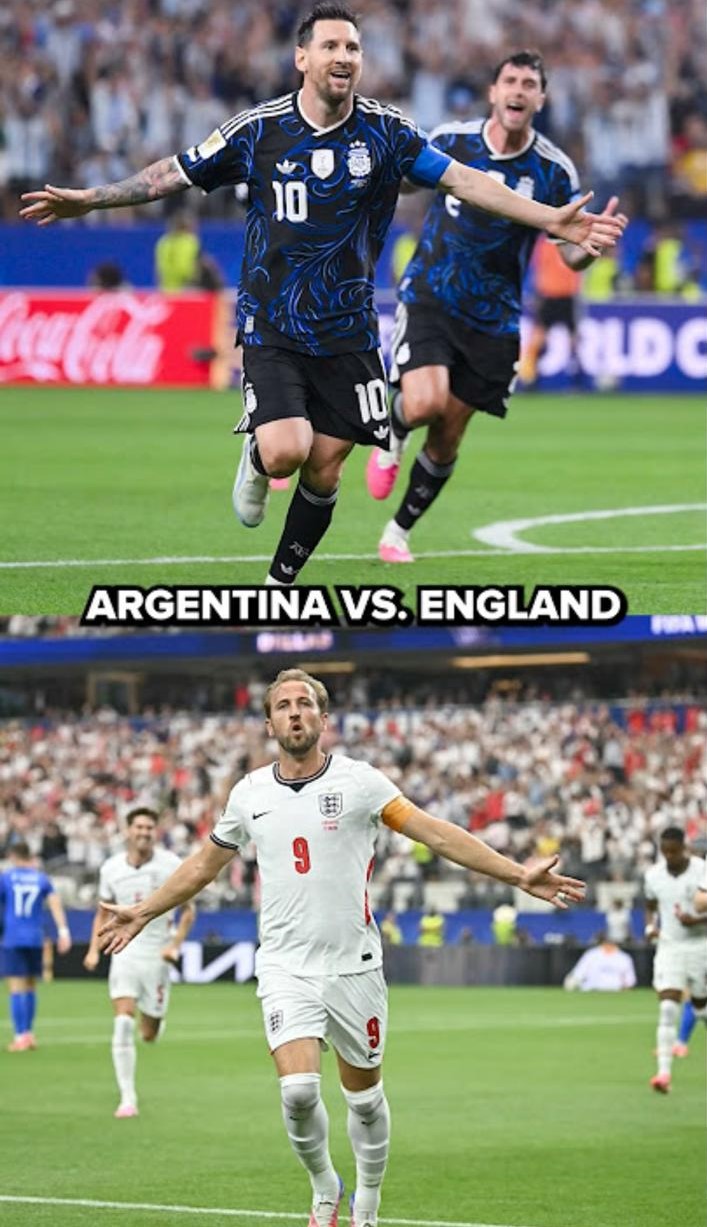
How One World Cup Semifinal Became a Masterclass in Leadership, Belief, and Championship Mentality
BY PAUL LUCKY OKOKU
When an Entire City Dared to Dream
There are football matches.
Then there are football moments that quietly become history.
They begin like every other game—with a whistle, a ball, and twenty-two players.
Yet somewhere between hope and heartbreak, they become stories that generations continue to tell.
England versus Argentina has always been one of those stories.
On a warm summer afternoon in Atlanta, another unforgettable chapter was written.
Cities have personalities.
Some simply host football tournaments.
Atlanta embraces them.
For weeks, the FIFA Fan Festival transformed downtown Atlanta into a celebration of the world’s game. Every street echoed with different languages. Restaurants overflowed with supporters wearing shirts from every continent. MARTA trains became moving galleries of colours, songs and anticipation.
Children chased footballs through public parks while parents debated tactics over coffee. Complete strangers became friends simply because they shared a love for the beautiful game.
Atlanta did far more than welcome the FIFA World Cup.
It celebrated it.
Long before FIFA arrived, Atlanta United Football Club had already demonstrated that football had found a permanent home in the American South. Match after match, Mercedes-Benz Stadium welcomed crowds that rivalled many of the world’s biggest clubs.
The World Cup merely confirmed what Atlanta had been proving for years.
Football belongs here.
Then came England versus Argentina.
Not merely another semifinal.
A rivalry.
A reunion with history.
And perhaps the tournament’s most compelling tactical battle.
Some matches are remembered because of spectacular goals.
Others because of controversy.
This semifinal will be remembered for something deeper.
It reminded us that championships are often shaped not only by talent, but by belief, patience, resilience and leadership—qualities that rarely appear on the scoreboard, yet often determine who ultimately triumphs.
England earned the lead.
Argentina earned the ending.
Between those two moments lay one of football’s enduring truths:
Winning a match and finishing a match are rarely the same challenge.
“Success is not final, failure is not fatal: it is the courage to continue that counts.” — Winston Churchill
Few sporting occasions illustrate that truth more powerfully than a World Cup semifinal.
Championship teams do not abandon their identity when adversity arrives. They trust it even more.
Atlanta: More Than a Host City
One of the biggest winners of this FIFA World Cup may never lift the trophy.
It may be Atlanta.
For several unforgettable weeks, the city became football’s meeting place.
Supporters exchanged scarves, shared meals, sang together and reminded the world why football remains the only sport capable of making complete strangers feel like lifelong friends.
As someone privileged to witness several matches here, I saw something television cameras could never fully capture.
Atlanta was not pretending to love football because the World Cup had arrived.
Atlanta already loved football.
The tournament simply gave the city an opportunity to share that passion with the world.
A Rivalry That Refuses to Grow Old
Every generation inherits its own England versus Argentina story.
Some remember England’s triumph in 1966.
Others remember Diego Maradona’s unforgettable afternoon in Mexico in 1986—first the controversial “Hand of God,” then what many still regard as the greatest goal ever scored in a World Cup.
Another generation remembers France ’98.
Others remember England’s measure of redemption in 2002.
Now Atlanta has added another chapter.
This one belonged neither to Maradona nor Beckham.
It belonged to Lionel Messi, Thomas Tuchel and two nations determined to write another page in football history.
That is the beauty of great rivalries.
They never truly end.
They simply introduce new heroes.
England’s Dream Began to Feel Real
For much of the afternoon, Thomas Tuchel’s game plan deserved genuine admiration.
England were disciplined.
Compact.
Patient.
They frustrated Argentina’s rhythm and denied the defending champions the freedom they usually enjoy.
Then came the breakthrough.
Anthony Gordon’s goal ignited not only England’s supporters but many neutrals inside Mercedes-Benz Stadium who sensed they might be witnessing another memorable World Cup upset.
For nearly thirty minutes, England stood within touching distance of the final.
The tactical plan appeared to be working.
The dream appeared within reach.
But football has a habit of asking every team one final question before rewarding it with victory.
Can you finish what you have so brilliantly started?
That question would soon define not only England’s afternoon, but Argentina’s response.
Champions Think Differently
One goal can change a football match.
It can also change the way both teams think.
When Anthony Gordon gave England the lead, belief swept through the English supporters inside Mercedes-Benz Stadium. For nearly thirty minutes, the World Cup Final appeared within reach.
England had earned that moment.
But champions often see the same moment differently.
Where others see pressure, they see opportunity.
Where others begin protecting the lead, they begin searching for the equaliser.
That psychological difference often separates good teams from great ones.
England were trying to preserve history.
Argentina were trying to write it.
The Messi Effect: Leadership Beyond Statistics
There comes a point in every great player’s career when goals and assists no longer tell the complete story.
Lionel Messi has reached that point.
The statistics will remember another appearance.
Another assist.
Another World Cup Final.
Yet those numbers explain only part of his influence.
Watching from a midfielder’s perspective, I noticed something far more significant.
Messi never allowed the occasion to rush him.
He demanded possession without forcing the game.
He slowed Argentina’s rhythm when patience was needed.
He accelerated attacks when opportunities appeared.
That is leadership.
Leadership is not always loud.
Sometimes leadership is simply remaining calm while everyone else feels anxious.
Great players inspire.
Great leaders reassure.
On this afternoon, Messi quietly did both.
Statistics Tell the Story Behind the Scoreline
Every scoreboard tells us what happened.
The statistics and decisive moments help explain how it happened.
Final score: Argentina 2–1 England
55th minute — Anthony Gordon, England
Gordon gave England the lead and placed Thomas Tuchel’s side within touching distance of the World Cup Final.
85th minute — Enzo Fernández, Argentina
Fernández restored parity as Argentina’s sustained pressure finally produced the equaliser.
90+2 — Lautaro Martínez, Argentina
Martínez completed the comeback in stoppage time and sent the defending champions into another World Cup Final.
Lionel Messi provided the assists for both Argentina goals, influencing the result not through scoring himself, but through the vision, patience and precision that have defined his greatness.
England’s organisation frustrated Argentina for long periods. Yet as the match unfolded, the balance gradually shifted. Argentina controlled more possession, their passing became sharper, and their attacks grew increasingly sustained.
Perhaps the most revealing figure came after England took the lead. From Gordon’s goal until Argentina’s winning goal, England reportedly managed only 12 per cent possession, illustrating the intensity of Argentina’s control during the decisive closing period.
The defending champions continued asking questions until England finally ran out of answers.
Statistics alone never tell the complete story.
Football without context is incomplete.
The strongest analysis respects both.
Statistics tell us what happened. Football explains why it happened.
Through the Midfielder’s Lens
Watching this semifinal as both a former international midfielder and a football analyst, I found myself admiring two very different qualities.
England demonstrated remarkable organisation.
Argentina demonstrated remarkable belief.
One earned the advantage.
The other refused to accept the disadvantage.
That distinction ultimately decided the semifinal.
Far too often, football analysis becomes an exercise in assigning blame.
This match deserves something better.
England did not simply lose control.
Argentina gradually took control.
Those are not the same story.
One diminishes England’s performance.
The other gives proper credit to a champion that never stopped believing.
The best analysis does not choose one truth over another.
It recognises both.
Did England Lose It… Or Did Argentina Simply Refuse to Lose?
That question will probably divide football supporters for years.
Some will insist England threw away their opportunity.
Others will argue Argentina demonstrated exactly why they remain world champions.
There is truth in both viewpoints.
England earned the lead through discipline, structure and tactical commitment.
Argentina earned the comeback through patience, persistence and unwavering belief.
Football rarely offers simple explanations.
Momentum shifts.
Confidence changes.
Tiny decisions accumulate.
Eventually one team discovers the decisive moment.
Rather than asking only,
“Who made the mistake?”
Perhaps we should also ask,
“Who continued searching for the solution?”
Argentina never stopped searching.
Eventually, football rewarded them.
Leadership Means Deciding Before the Outcome Is Known
Every World Cup reminds us that football is ultimately a leadership game.
Players perform.
Leaders decide.
Thomas Tuchel now finds himself at the centre of countless tactical debates.
Should he have remained more attacking?
Should he have refreshed the midfield earlier?
Should England have defended differently?
Those are fair questions.
They deserve discussion.
But they also deserve perspective.
Leadership is never exercised after the result is known.
Leadership is exercised before it.
Every substitution represents a judgement.
Every tactical adjustment represents a calculated risk.
Every coach makes those decisions believing they improve the team’s chances.
Whether those decisions succeed becomes clear only after the final whistle.
That is the burden every coach accepts.
The “Monday Morning Quarterback” Syndrome
In the United States there is a well-known expression:
“Monday morning quarterback.”
The phrase comes from American football, where traditionally most professional games are played on Sunday. By Monday morning, the games have ended. Supporters have watched every replay, studied every statistic and concluded exactly what the coach or quarterback should have done differently.
With hindsight, every decision appears obvious.
Football offers no such luxury.
Thomas Tuchel did not have Monday morning.
He had Wednesday afternoon.
He had seconds—not hours.
He had tired players.
Changing momentum.
An opponent growing stronger.
And a World Cup Final hanging in the balance.
Supporters have every right to question his decisions.
Former players and pundits have every right to disagree with his tactics.
Healthy debate is part of football.
But hindsight should never pretend it was standing beside the coach when the decision had to be made.
There is a profound difference between analysing a decision and making one.
Beyond the Final Whistle
Before We Criticise the Coach, Let Us Stand in His Technical Area
Football has a remarkable way of changing our perspective.
Anyone who has played the game at a high level eventually discovers something supporters watching from the stands cannot fully appreciate.
The burden of leadership.
That is why criticism should always be balanced with understanding.
Coaches should be held accountable.
Players should be evaluated honestly.
Supporters deserve thoughtful analysis.
But thoughtful analysis also requires fairness.
Following England’s defeat, many former players, experienced coaches and television pundits questioned Thomas Tuchel’s substitutions. Some believed he became too defensive. Others argued he should have continued attacking.
Those opinions deserve respect.
Football has always welcomed healthy debate.
Yet one question continued to stay with me.
If you had been standing inside that technical area, with millions watching around the world, a World Cup Final within touching distance, and only seconds to make a decision… what would you have done?
More importantly…
Would you have made that decision believing it gave your team the best chance to win?
Every sincere coach would almost certainly answer the same way.
Yes.
No coach deliberately weakens his own team.
No coach makes a substitution hoping it will eliminate his nation from the World Cup.
Every decision is made with one purpose:
To increase the probability of victory.
Sometimes football rewards those decisions.
Sometimes it does not.
That uncertainty is the price every leader accepts.
Lionel Messi and the League They Said Would End His Greatness
When Lionel Messi chose Inter Miami and Major League Soccer, many critics declared that he had chosen comfort over competition.
Some even suggested he had quietly stepped away from football’s biggest stage.
The 2026 FIFA World Cup has offered a powerful response.
Messi has not merely reached another World Cup Final.
He has continued to redefine greatness while playing on American soil.
Rather than diminishing his legacy, his move to MLS has expanded football’s influence across the United States. Stadiums sell out. Television audiences continue to grow. Young players wear pink Inter Miami shirts because of one man.
*The league did not make Lionel Messi smaller. Lionel Messi made the league bigger.+
History may ultimately remember that his greatest contribution to American football was not measured only in goals and assists, but in belief—belief that the world’s greatest players could help accelerate the growth of the world’s game in America.
Those who once dismissed MLS as the place where great careers quietly ended may now have to reconsider.
Sometimes pioneers are misunderstood before they are celebrated.
- The Final Football Deserved*
The Final Football Deserved
After more than five unforgettable weeks of football and the dreams of forty-eight nations, only two remain.
Spain.
Argentina.
On Sunday, July 19, at 3:00 p.m. Eastern Time, the football world will turn its attention to MetLife Stadium in East Rutherford, New Jersey—known during the tournament as New York New Jersey Stadium— where the 2026 FIFA World Cup champion will be crowned.
Spain have illuminated this tournament with fearless, possession-based football.
Argentina have reminded the world why champions are defined as much by resilience as by talent.
One represents the brilliance of youth.
The other embodies the wisdom of experience.
And just beyond the Hudson River, New York will not merely host the World Cup Final.
It will become football’s heartbeat.
The streets will pulse with songs from every continent.
Scarves will wave above crowded sidewalks.
Supporters will gather in parks, restaurants and public squares, each carrying the hopes of a nation.
For one unforgettable afternoon, the city that never sleeps will surrender itself to the game that never stops inspiring.
Whatever happens when the final whistle blows, football will have given the world a worthy conclusion.
This is not simply the final we expected.
It is the final this remarkable World Cup has earned.
Conclusion: Football’s Greatest Gift Is Perspective
Years from now, many supporters will remember only one fact.
Argentina defeated England.
Football deserves a richer memory.
England played with courage.
Argentina played with conviction.
Thomas Tuchel made difficult decisions under extraordinary pressure.
Lionel Messi once again demonstrated that leadership is measured not only by talent, but by composure, belief and the ability to inspire others when everything is on the line.
When the final whistle sounded in Atlanta, England departed with heartbreak.
Argentina departed with hope.
Football left all of us with another timeless reminder.
Championships are rarely won by talent alone.
They are won by belief that refuses to disappear when the scoreboard says otherwise.
From a Midfielder’s Eye — Where football reveals its soul, leadership finds its voice, and every final whistle gives way to stories, lessons, and memories that endure far beyond the scoreline.
Share Note
If this editorial challenged the way you think about football, coaching or leadership, please share it with fellow supporters, coaches, players, students and aspiring leaders. The beautiful game has always been more than ninety minutes. It remains one of life’s greatest classrooms.
Paul Lucky Okoku
FIFA Legend | Football Analyst | Journalist-at-Large | CAF Africa Cup of Nations Silver Medalist | Former Nigerian Super Eagles & Flying Eagles International | Former Vice-Captain, Flying Eagles | Former Olympic Qualifying Team Member | Founder & CEO, Greater Tomorrow Children’s Fund (GTCF)