
BY SHOMADE ADEBAYO MOSES
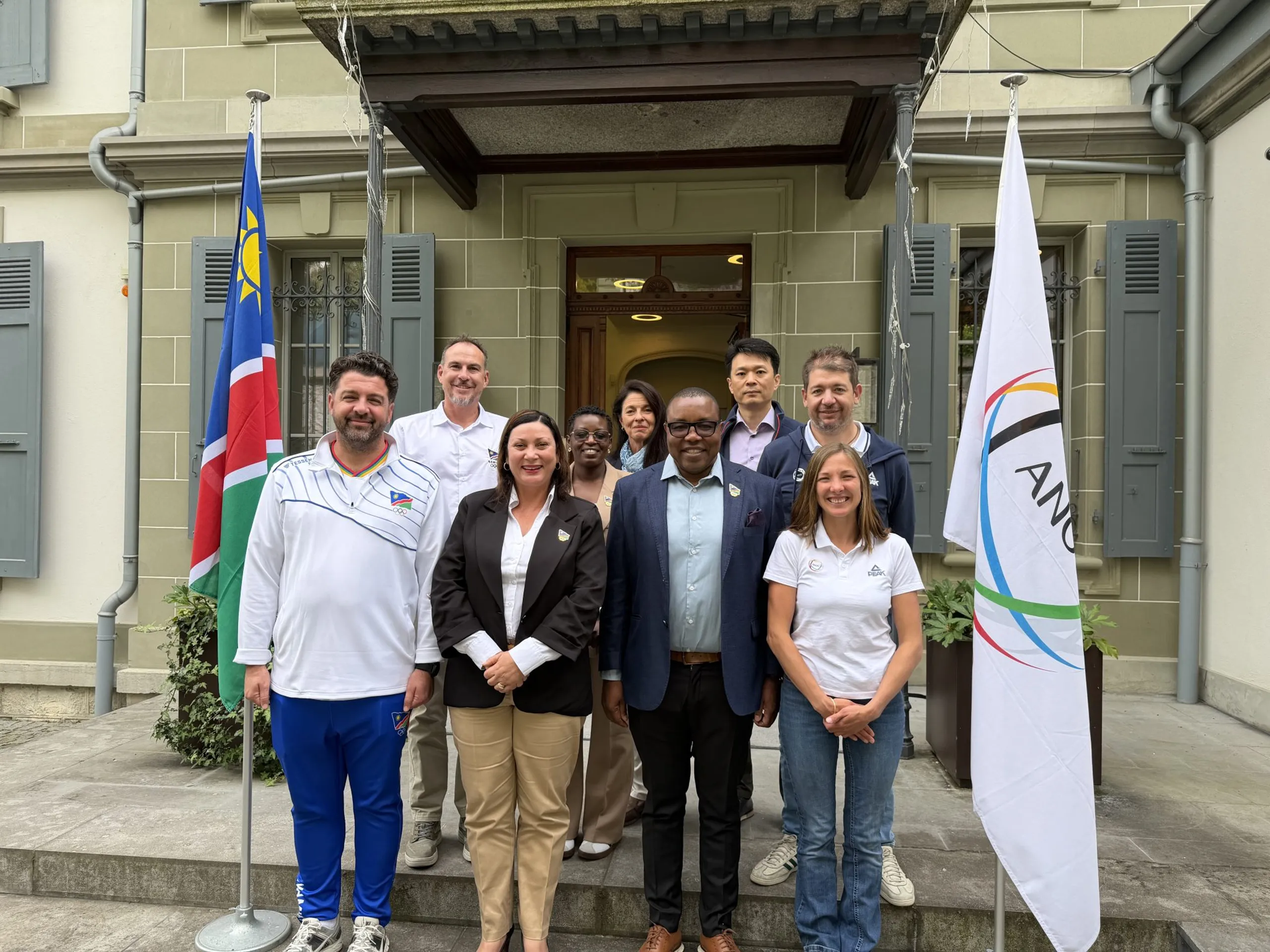
The Namibia NOC visited the headquarters of the Association of National Olympic Committees in Lausanne this week to review various initiatives, including the ‘Peak Uniform Programme’, through which athletes will be provided with high-quality sportswear.
The names of those selected have not yet been announced. NOC officials will compile the list from the pre-selected athletes who are due to travel to Senegal. This is made possible thanks to the programme, which supports countries — particularly those with fewer resources — by providing sports equipment for their delegations. Through this initiative, PEAK provides competition, training and ceremonial clothing, helping to overcome budgetary constraints and reduce significant costs associated with international participation.
The Namibian delegation that travelled to Lausanne included Minister Sanet Steenkamp, Deputy Minister Dino Ballotti and NOC President Ndeulipula Hamutumwa, as well as other officials. Participants in the meeting held discussions aimed at improving athlete development, with the Youth Olympic Games in Dakar, scheduled from 31 October to 13 November, as the key event on the horizon.
The strong collaboration between the Namibia NOC and the Ministry of Sport was highlighted, covering joint work on programmes from grassroots level through to elite performance pathways. The hosts also reviewed the implementation and operation of the ‘ANOC Digital Accelerator Programme’, which continues to play a pivotal role in bolstering the digital capabilities of NOCs. The Namibian delegation shared its experience of the Paris 2024 Olympic Games, during which Namibian athletes participated in interviews at the ANOC.tv studio. This helped to increase their visibility and strengthen engagement with global audiences.
ANOC’s support for national delegations includes providing resources, implementing training courses to share knowledge and skills, and maintaining regular contact to strengthen relationships. Some ongoing programmes, such as the uniform initiative, are typically implemented at major events such as the Dakar 2026 Games and other competitions under the Olympic umbrella. This ensures that athletes compete with a professional, unified image that is comparable to that of delegations with greater resources. Beyond the logistical aspect, the programme also has a symbolic dimension as it promotes equal opportunities.
In the case of Namibia, its sports scene has been steadily growing on the continental and international stages. The country’s most important discipline is athletics, in which it won its only Olympic medals to date thanks to Frankie Fredericks’ achievements.
He was a national sporting icon in the 1990s and early 2000s, winning four silver medals in the 100 m and 200 m at the 1992 Barcelona and 1996 Atlanta Olympics. Since then, Namibia has competed in every Olympic Games, although without reaching the podium. Boxing and rugby are among the sports in which Namibian athletes have also established a presence, with participation in World Championships and final stages but without top results.